Saturday, September 23, 2006


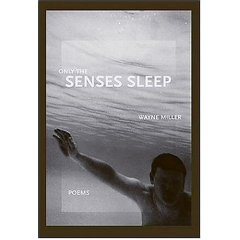
Reading Wayne Miller's ONLY THE SENSES SLEEP, just out from New Issues. Or I guess the technical pub date is 10/1, but you can get it already. Highly recommended.
*

Also reading Alice Notley's new book ALMA, OR THE DEAD WOMEN. It's a bit of an uphill climb, but full of gems. Sort of a deeply obscured novel in prose poems and verse, or the other way around. The cover is utterly beguiling.


*

Now I'm off to see Alex Lemon read with B at the Burning chair in Brooklyn. I guess the L trains out, but you should come anyway.

Thursday, September 21, 2006


OK, so I’ve pretty much established myself as an infrequent blogger. That’s the truth—what can I do. Thanks to those who still check in.

*

What have I been reading? Of late, my favorite book of poetry is THE BEST OF MY LOVE by Aaron Kiely, from Ugly Ducking. He’s brilliant, earnest, right about everything he says. This book is better than most books I’ve read in a while. Get it! Get that and Alice Notley’s selected poems.

*

The Yale Review took a poem recently. I’m excited about that.

*

Check out the new FORKLIFT, OHIO, in which a poem of mine appears. Especially check out Matthea Harvey’s poem, “Dinna Pig,” in the same issue. You can see her poem on line, though for mine you’ll have to find a copy of the print edition, and I think it’s mail order only.

*

I’m listening to fusion-era Miles Davis right now. And I’m drinking water.

Monday, September 04, 2006


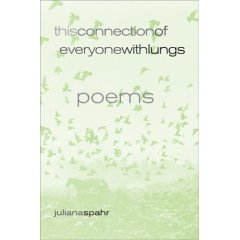
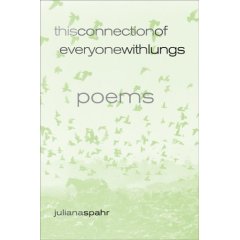
THIS CONNECTION OF EVERYONE WITH LUNGS: POEMS
by Juliana Spahr, Univ. of California (2005)

This fast-moving collection is one of the more effective poetic responses to 9/11 that I’ve read so far. It’s composed of two extended pieces in prose, the second far longer, though perhaps ultimately less moving, than the first.

That first piece, matter-of-factly titled “Poem Written After September 11, 2001,” overtly references that day only in the title. The poem itself is an attempt at consolation and the assumption of responsibility by the individual for the events that take place in the larger world, seemingly outside of the sphere of individual influence. By an impressive act of linguistic accretion, Spahr manages to illustrate how each individual in factually, if not scientifically, connected to every other, and is therefore responsible for everyone else. She begins like this (I will use this symbol “#” below to separate quoted text from my own writing):

#

There are these things:

cells, the movement of cells and the division of cells

and then the general beating of circulation

and hands, and body, and feet

and skin that surrounds hands, body, feet.

This is a shape,

a shape of blood beating and cells dividing.

#

Soon she shows us this:

#

There is space around the hands and space in the room


Everyone with lungs breaths the space in and out as everyone
with lungs breathes the space between the hands in and out

#

Toward the end of the poem, several pages later, she has built up to this:

#

as everyone with lungs breathes the space between the hands
and the space around the hands and the space of the room and
the space of the building that surrounds the room and the space
of the neighborhoods nearby and the space of the cities and the
space of the regions and the space of the nations and the space
of the continents and islands and the space of the oceans and the
space of the troposphere in and out

#

While the experience of reading this work can get a bit tedious (she adds another element to the growing list with each new stanza/paragraph), which is my only real issue with this poem, Spahr manages to take us through, or lead us into, a prolonged act of empathy. By the end, it seems impossible to think of oneself as anything but a part of a minutely interconnected system, which, hurt at any one point, is hurt throughout. Hence, by titling the poem as she does, she shows us all to be responsable for the events and aftereffects of the Trade Tower bombings. It’s at once a grand gesture of consolation and a powerful call to do something to repair the damage.

That gestures segueways into the second part of the book, which takes up most of its pages. It’s called “Poem Written from November 30, 2002, to March 27, 2003.” It’s made up of many several-page sections titled with their dates of composition. In it, Spahr narrates her own observation of the TV news as the bombing of Afghanistan and the War in Iraq gets underway. The poem is set in Hawaii, where Spahr is living along with a lover. She addresses the lover and us throughout as “Beloveds,” and, once again, links us to the unfolding events of the war:

#

When I speak of your thighs and their long muscles of smooth-
ness, I speak of yours cells and I speak of the British Embassy
being closed in Kenya and the US urging more aggressive Iraq
inspections and the bushfire that is destroying homes in Sydney.

#

I like this piece less than I like the first, in part because reading it is more tedious, and because the language is sometimes so journalistic it approaches regular prose, and because I have a bit more trouble buying Spahr’s syntheses of self and other in the poem. But, unifying the whole piece is a consoling, guilty tone—the same as in the first piece—that I find very remarkable.

Overall, I think this book is an important piece of 9/11 literature that in fact expresses the complex ambivalence many Americans have felt since 2001. I hadn’t heard much about the book and came to own a copy of it in a rather random way. I think it ought to be read by any sensitive person looking for a way to articulate their own feelings about the last few years in American life.

Monday, August 21, 2006

Spent the weekend mostly hanging out with B and working on this piece I'm writing about Paul Muldoon. Also reading Lynda Hull's Star Ledger, which takes a bit of work to get into, but is really something once you're in. She's a kind of mix of Bishop, Rick Moody, Deborah Eisenberg, Amy Hempell, and I can't think of who else, though these are just the writers who come to mind right now, and they're probably not the right ones to describe her work. Also reading The Aeniad. Yup, that's what I'm doing with my weekend. Crazy.

Saturday, August 12, 2006

B and I have been listening to music tonight and having a wonderful extended conversation about how music shapes and fosters the identity of its listeners. A strange thing, music—a song is an aesthetic object, but it also exists in time, must be listened to, or at least rehearsed in the mind to have its effect. One can’t simply take away from a song one’s interpretation and be done with it; one needs to experience it, in the moment, to have any sense of what it is. If one is being a purist, the same is true of poems—they don’t mean anything, they are things. But we have so much trouble with that idea. In schools, poems are taught like puzzles, depriving would-be readers of poems’ true powers, which are to be things, to create experiences out of language, a medium we otherwise think of in terms of what it means. I’ve been having a little discussion with Andrea Baker on her new blog about this very issue in the poems of Kay Ryan. It took me years after high school to overcome the idea of “interpreting” poems. Now that I’m no longer anxious about understand what poems “mean,” I’d hate to go back to that other way of thinking about them. Which, of course, is not to say I want poems to simply be musical. I just never want to worry about paraphrasing them again. At their best, poems bring us back to a purer experience of language, to the place just before it means anything, to where words reach out to the things they refer to, but don’t quite grasp them, because once they grasp them, they’re dead.

Thursday, August 10, 2006

Trying to take a break from always writing/ worrying about writing. Certainly for me it takes on many of the characteristics of an unhealthy addiction all too often. Anyone else know the feeling?

So, I’m devoting myself to loafing around with B, playing my new ukulele (one of the spoils of my honeymoon), and reading a novel purely for pleasure, which I shall not write a word about.

Sunday, August 06, 2006


Cool! This is a word cloud that shows the most common words used on my blog. Got the idea from C.Dale Young's blog. Try it. Weird: http://www.snapshirts.com/custom.php?sid=6d5cedcb3207ebbe6ab1b4f9e3588e76
My album purchases this week: BRIAN ENO: TAKING TIGER MOUNTAIN (BY STRATEGY) and PATTI SMITH; HORSES. guess which one is better…

Ok, so I’m drunk now…

Pattie Smith is better, of course. Because she’s unafraid of her passion, no matter where it directs her. While Eno has very clear plans for where his passion, at least on this album, should go, though on later albums (like MUSIC FOR AIRPORTS) it’s less constricted.

Friday, August 04, 2006

“…If poetry is knowledge, it is a forbidden one. These are not the kind of thoughts Mommy and Daddy are thinking as they sit in the parlor. The clearheaded are lonely. As for torments of self-doubt, could there be Art without it? Well, yes, surely, but not the kind that would have any meaning to Emily Dickinson and Louise Glück.”


The above passage is from Charles Simic’s review of Glück’s latest book, Averno— which, if you happen to have been reading my blog around the time of its release, you’ll remember I went on about quite a bit—published in the 6/22 issue of The New York Review of Books. It’s a very, very fine review, really Simic’s take on Glück’s whole career. He likes the early books and, of course, The Wild Iris, and, rightly, has some reservations about the books between that book and the new one. But he portrays Glück as nothing less than the very great and utterly powerful writer that she is.

As taken as I always am with Glück, I’m also very moved by Simic’s clarity and emotion as a critical writer. I wish I wish I could write lovely sentences like those quoted above, which not only say something deft and moving about the work, but, at the same time, leaping off the work, about what it is like to be human. Criticism should justify itself beyond its function as a window into particular works of literature by being compelling literature in it’s own right. That’s not a new idea, I know, but reading this wonderful essay on a writer I love by a writer who has also been very important to me—seeing what a good critic Simic can be—reminds me what good criticism can do.
I’ve been listening, sort of obsessively, to Talking Heads for the past month or so, especially to three albums produced by Brian Eno: MORE SONGS ABOUT BUILDINGS AND FOOD, FEAR OF MUSIC, and REMAIN IN LIGHT (which I think is one of the best albums I know of). David Byrne was on hand to speak for—and from within—the ambivalent moment when late 70’s and early 80’s culture was reacting to, even clamping down on, the irresponsible ethos of the late 60’s and early 70’s. It was, I think, a confused moment, and Byrne understood the earnest desire to seek stability—through stable jobs, houses, committed relationships—as well as the undercurrent that came with that desire, which knew that that kind of stability was precarious, even a lie.

Tomorrow, I will endeavor to purchase Eno’s TAKING THE TIGER BY STRATEGY. I’m always late (two decades) on these things, but I find my way to them.